

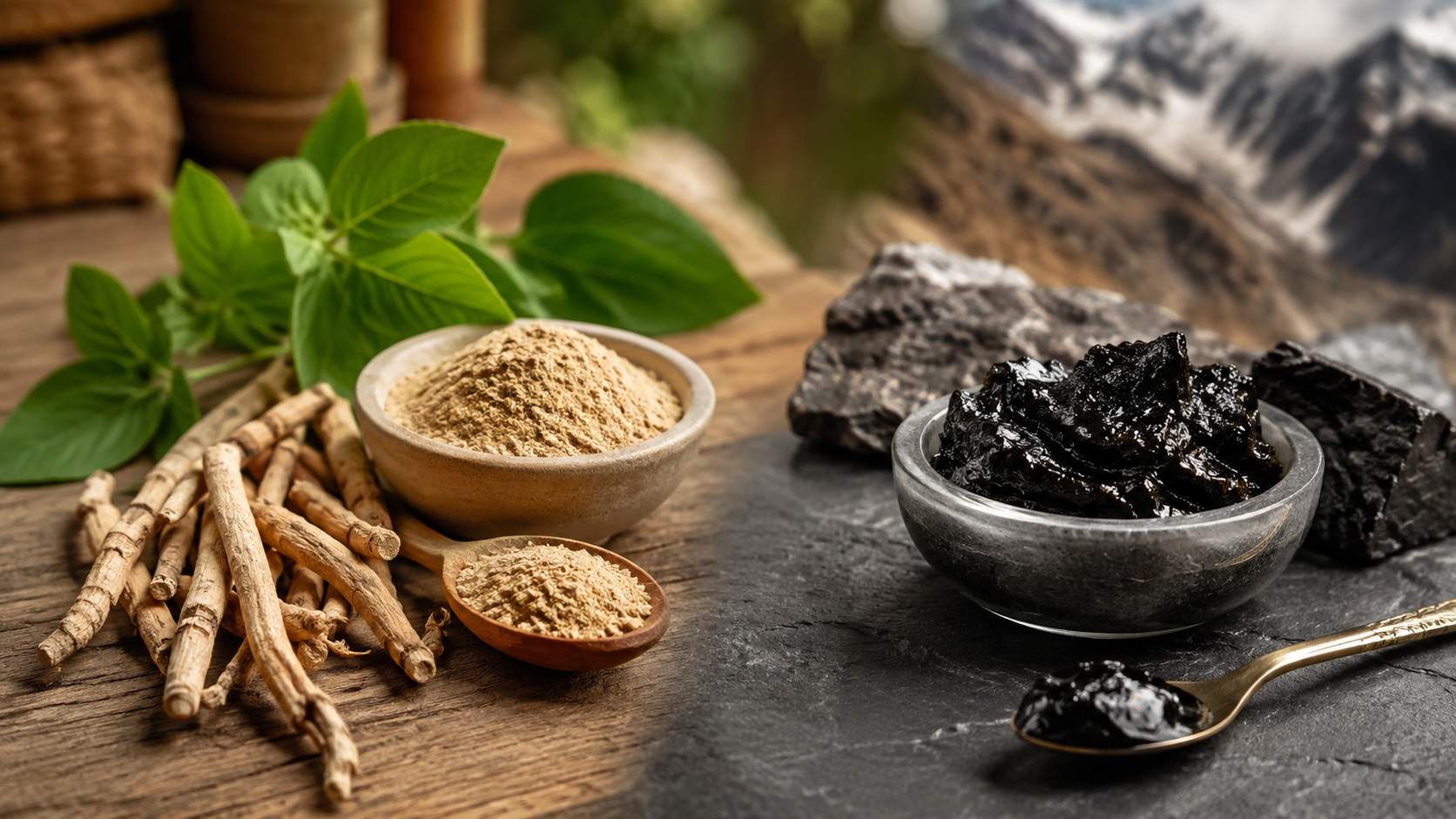
Ashwagandha vs Shilajit: Herb Extract or Mineral-Rich Substance?
Ashwagandha vs Shilajit is a comparison between two very different supplement materials. Ashwagandha comes from the plant Withania somnifera. Shilajit is a dark, complex substance collected from rock formations and commonly described as a phyto-mineral exudate. This guide explains how their identities, labels, evidence, processing, and safety concerns differ.
Both have long histories in South Asian traditions. That shared context does not make them interchangeable. Ashwagandha quality depends heavily on botanical identity and extract specifications. Shilajit quality depends on source material, purification, chemical variability, and contaminant testing.
What is the short answer?
Ashwagandha is an herb. Shilajit is not. Ashwagandha supplements contain root powder, root extract, or root-and-leaf extract. Shilajit contains a variable mixture of organic substances, trace elements, and other naturally occurring material.
The milligrams on their labels cannot be compared as though they measure equivalent ingredients. A standardized botanical extract and a purified shilajit preparation have different compositions, manufacturing concerns, and research histories. Reliable head-to-head evidence is lacking.
| Comparison point | Ashwagandha | Shilajit |
|---|---|---|
| Ingredient category | Botanical powder or extract | Variable organic and mineral-containing substance |
| Identity | Withania somnifera | No single botanical species |
| Main label details | Plant part, extract ratio, withanolides | Source region, purification, fulvic acid claim, batch testing |
| Common formats | Capsules, powders, tablets, liquids, gummies | Resin-like paste, capsules, tablets, powders, liquids |
| Major quality concern | Correct species and extract identity | Composition, purification, heavy metals, and contaminants |
| Human evidence | Limited but broader | Few small product-specific studies |
What exactly is ashwagandha?
Ashwagandha is the common name for Withania somnifera, a shrub used in Ayurvedic and Unani traditions. Most commercial products contain root extract. Some use root-and-leaf extract or plain root powder. These preparations do not have identical chemical profiles.
Withanolides are commonly used as marker compounds. A label may state the extract weight and a withanolide percentage. These specifications help describe the ingredient, but they do not establish that every extract with the same percentage has identical composition.
Human studies have examined perceived stress, sleep, cognition, and other measurements. Most trials have been small and short. They have also used different plant parts, extraction methods, and serving amounts. Results from one standardized extract should not be assigned to all ashwagandha products.
What exactly is shilajit?
Shilajit is a blackish-brown material associated with mountain rock formations. It is also known by names such as mumijo, moomiyo, and mineral pitch. Researchers do not describe its exact origin and complete composition with complete certainty.
Published analyses describe shilajit as a mixture containing humic substances, including fulvic acid fractions, along with minerals, trace elements, amino acids, and other compounds. Composition can change with geography, collection conditions, processing, and analytical method.
The term phyto-mineral is descriptive. It is not a guarantee of identity, purity, or nutritional value. Shilajit is also not a single mineral. Calling it mineral-rich provides little useful information unless the label or batch report quantifies specific minerals and confirms acceptable contaminant levels.
Why does purification matter for shilajit?
Raw shilajit can contain soil, rock particles, environmental material, microorganisms, and metals. Commercial processing may include washing, filtration, extraction, concentration, or other purification steps. Methods differ between manufacturers.
The word purified does not explain which contaminants were removed or which analytical limits were applied. It should be supported by batch-specific laboratory results. A general statement about traditional purification is not equivalent to modern identity and contaminant testing.
Lead, arsenic, cadmium, and mercury deserve particular attention. These metals can accumulate in the body with repeated exposure. Their natural presence in the environment does not make them desirable supplement ingredients.
The practical quality difference
Ashwagandha buyers mainly need to confirm the correct species, plant part, and extract. Shilajit buyers also need evidence that a variable natural substance was adequately purified and tested for heavy metals and microbial contamination.
 How does the research compare?
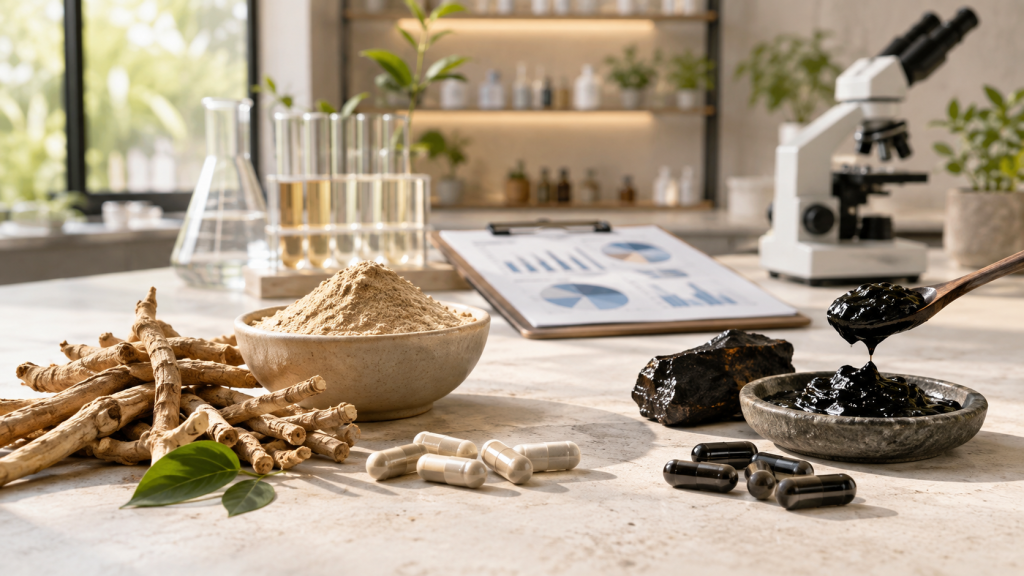 How does the research compare?
Ashwagandha evidence is extract-specific
Ashwagandha has a larger human research base than shilajit, but the evidence still has limitations. Trials often study proprietary extracts in selected populations for several weeks. Different root and root-and-leaf products should not be grouped as one uniform intervention.
Shilajit evidence is narrow
Only a small number of controlled human studies have evaluated purified shilajit preparations. Some have examined hormone measurements, fatigue-related exercise outcomes, or other laboratory endpoints. The studies used specific processed products and selected participants, often adult men.
One randomized trial, for example, studied a purified preparation in men aged 45 to 55 for 90 days. That narrow design cannot establish what an untested resin, powder, or multi-ingredient formula will do. It also does not provide general guidance for women, younger adults, older adults, or long-term users.
Neither category supports a universal ranking
No reliable evidence shows that ashwagandha is universally stronger than shilajit or that shilajit provides broader effects because it contains many compounds. More components can create more variability. They do not automatically create a better supplement.
How should you compare the labels?
Ashwagandha identification
Look for Withania somnifera, the plant part, serving size, extract ratio, and withanolide information. Check whether the formula includes piperine, minerals, or additional botanicals.
Shilajit identification
Look for the source region, physical format, extraction or purification description, amount per serving, and any declared fulvic acid specification. Confirm whether the product contains pure shilajit preparation or a blend.
Laboratory documentation
A useful certificate of analysis should identify the batch and show actual results rather than vague pass statements. Relevant fields include lead, arsenic, cadmium, mercury, microbial limits, and ingredient identity. Independent testing has more value when the report names the laboratory, method, batch, and acceptance limits.
Does fulvic acid prove shilajit quality?
No. Fulvic acid is one component associated with humic substances. A fulvic acid percentage does not confirm the complete chemical profile, geographic authenticity, purification quality, or absence of contaminants.
Testing methods can also produce different results. Two products listing similar fulvic acid percentages may not be equivalent. The number should be interpreted alongside identity data, processing details, and contaminant results.
Can ashwagandha and shilajit be used together?
Research on the specific combination is insufficient for a universal recommendation. A commercial blend containing both ingredients does not show that the formula has undergone a controlled human trial.
Starting both simultaneously also makes adverse reactions difficult to trace. Ashwagandha may cause drowsiness or digestive effects. Shilajit-related concerns can involve product composition, allergy, dizziness, blood pressure changes, or contamination. If professional guidance supports use, changing one variable at a time makes the result easier to interpret.
What safety differences matter?
Ashwagandha can cause stomach upset, loose stools, nausea, or drowsiness. Rare liver injury reports have appeared. It may also affect thyroid function and interact with sedatives, anticonvulsants, thyroid hormone, immunosuppressants, and medicines that influence blood pressure or blood glucose.
Ashwagandha should be avoided during pregnancy and breastfeeding. Professional review is important for thyroid or autoimmune conditions, liver concerns, upcoming surgery, and hormone-sensitive prostate cancer.
Short-term studies of selected purified shilajit preparations do not establish the safety of raw or untested products. Reliable long-term evidence is limited. Adverse reports have included allergic reactions, dizziness, disorientation, and blood pressure changes, although product quality and causality may not always be clear.
Pregnant or breastfeeding people, children, and people with complex medical conditions should not assume shilajit is appropriate because it is natural. Anyone using hormone-related medicines or considering a product marketed around testosterone should request professional review.
Ashwagandha and Alcohol
Alcohol introduces a third variable into an already uneven comparison. It can affect sleep, coordination, energy, hormone measurements, digestion, and next-day perception. Those changes make personal supplement tracking less reliable.
Ashwagandha may cause drowsiness and has been linked to rare liver injury reports. Shilajit does not neutralize alcohol or confirm that a product is free from heavy metals. Direct evidence does not establish a universal interval between alcohol and either supplement. Neither ingredient should be positioned as a way to offset alcohol-related fatigue or impaired alertness.
Ashwagandha and Shilajit Comparison Checklist
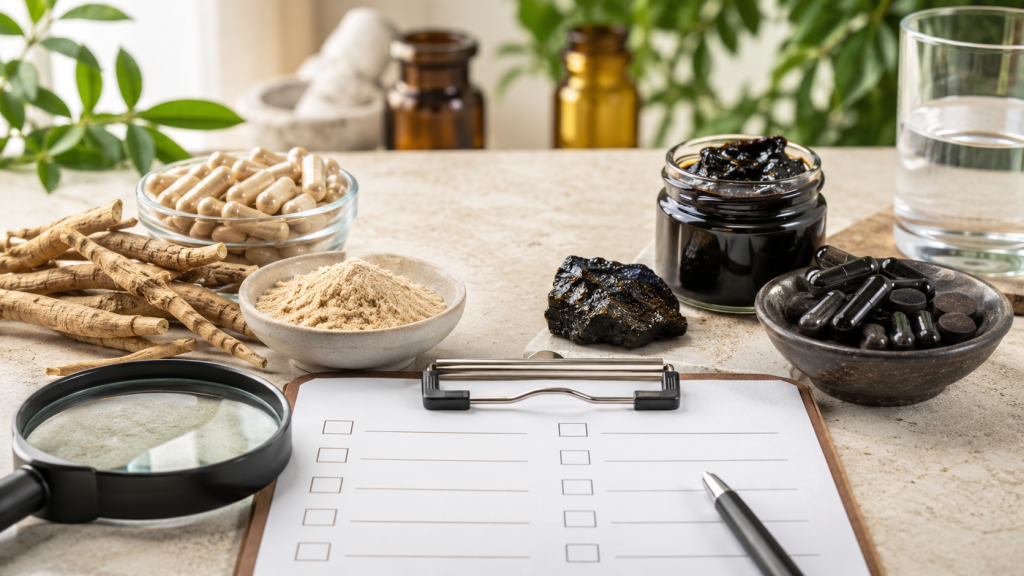 Ashwagandha and Shilajit Comparison Checklist
Use this checklist to compare real products rather than traditional reputation or front-label language. Ingredient identity and batch quality matter more than the number of claims on the package.
Name the material
Confirm whether the product contains an ashwagandha powder, botanical extract, purified shilajit preparation, or multi-ingredient blend.
Check the identity details
Find the species and plant part for ashwagandha. Find the source region, processing description, and physical format for shilajit.
Read the complete serving
Check how many capsules, tablets, scoops, or portions make one serving. Do not compare the two ingredients by milligrams alone.
Verify purification
Do not rely only on the word purified. Look for batch documentation that reports actual contaminant results.
Review heavy-metal results
Check lead, arsenic, cadmium, and mercury. Confirm that the report matches the lot number on the product.
Check personal risks
Review medications, pregnancy, breastfeeding, age, thyroid status, liver concerns, autoimmune conditions, and hormone-sensitive conditions.
Change one variable
If professional guidance supports use, introduce only one new product at a time. Record unwanted effects and stop using a product if a concerning reaction appears.
Часто задаваемые вопросы
Is shilajit an herb?
No. Shilajit is a complex natural substance associated with rock formations. It does not come from one identified botanical species.
Is shilajit a mineral?
Not exactly. It contains organic material and various minerals or trace elements, but it is not one mineral with a fixed composition.
Which has more human research?
Ashwagandha has a broader human research base. Its evidence is still limited by varied extracts, small trials, and short study periods.
Can ashwagandha and shilajit milligrams be compared?
No. The numbers measure different materials with different chemical compositions and manufacturing specifications.
Does purified shilajit mean it is free from heavy metals?
No. Purified is a processing claim. Batch-specific laboratory testing is needed to evaluate heavy-metal levels.
Does a high fulvic acid percentage prove potency?
No. Fulvic acid content does not establish overall composition, purity, contaminant status, or product performance.
Can ashwagandha and shilajit be combined?
Evidence on the combination is limited. Product quality, medications, medical conditions, and possible overlapping effects require review.
Is raw shilajit better than processed shilajit?
No reliable evidence establishes raw shilajit as superior. Raw material can contain debris, microorganisms, and environmental contaminants.
Can either ingredient offset the effects of alcohol?
No. Neither should be presented as a countermeasure for alcohol-related fatigue, sleep disruption, or impaired alertness.
Glossary
Botanical extract
A preparation made by extracting selected constituents from plant material.
Certificate of analysis
A document reporting identity, purity, and contaminant test results for a specific batch.
Fulvic acid
A fraction of humic substances often measured in shilajit preparations.
Heavy metal
A metallic element that may become harmful at sufficient exposure levels, including lead, arsenic, cadmium, and mercury.
Humic substances
Complex organic materials formed through the breakdown and transformation of biological matter.
Phyto-mineral
A descriptive term for material containing both organic and mineral components.
Purification
Processing intended to remove debris, contaminants, or unwanted constituents from raw material.
Standardized extract
An extract manufactured to provide a stated amount of selected marker compounds.
Withanolides
Compounds found in ashwagandha and commonly used as extract standardization markers.
Conclusion
Ashwagandha is an identifiable botanical, while shilajit is a variable organic and mineral-containing substance. Compare species, processing, batch testing, and evidence before considering either product.
Sources Used
- Ashwagandha identity, research, formulation, and safety overview, NIH Office of Dietary Supplements fact sheet – ods.od.nih.gov/factsheets/Ashwagandha-HealthProfessional
- Ashwagandha safety and medication interaction guidance, National Center for Complementary and Integrative Health – nccih.nih.gov/health/ashwagandha
- Shilajit identity, evidence limitations, adverse reports, and heavy-metal concerns, Operation Supplement Safety – opss.org/article/shilajit-dietary-supplement-ingredient
- Review of shilajit composition and geographic variability, PubMed – pubmed.ncbi.nlm.nih.gov/38133965
- Review of humic substances and heavy-metal profiles in shilajit, PubMed – pubmed.ncbi.nlm.nih.gov/38393486
- Product-specific randomized study of purified shilajit in adult men, PubMed – pubmed.ncbi.nlm.nih.gov/26395129
- Heavy-metal warning for certain Ayurvedic products, U.S. Food and Drug Administration – fda.gov/drugs/fraudulent-products/fda-warns-about-heavy-metal-poisoning-associated-certain-unapproved-ayurvedic-drug-products
- Alcohol interaction and impairment guidance, National Institute on Alcohol Abuse and Alcoholism – niaaa.nih.gov/publications/brochures-and-fact-sheets/harmful-interactions-mixing-alcohol-with-medicines